
Teaching on Purpose #8: Communicating meaning
Putting decision making at the heart of teaching

At Chiltern Learning Trust, we have six core purposes that capture everything teachers do:
Securing, maintaining and regaining attention
Communicating meaning
Driving hard thinking
Enable and scaffold practice
Utilising memory
Checking for understanding
Each week, I interview one of our teachers on the ‘Teaching on purpose’ podcast about a technique they commonly use to serve one of our six core purposes and I write about it here…
This week’s purpose: Communicate meaning
This week, I spoke to Yamina Bibi on her thoughts around the purpose of communicating meaning, what it means for her in practice and how she sees it fitting into her understanding of adaptive expertise.
Knowing your stuff…
We often think of communicating meaning in terms of what we observe. How a teacher models, the clarity of their explanations, the examples, analogies and non-examples they use. Sitting behind all this though is a body of knowledge that is hard earned and enables the kind of flexibility that we see in our best teachers.
One of Yamina’s biggest beliefs is in the power of intellectual preparation. We all have a tendency to go off on tangents in the moment of a lesson in our quest to help students make sense of a new concept. However, in the moment, we are far more likely to lean on an anecdote or experience that helped us to make sense of the concept rather than one specifically designed to help them make sense of it. So, how do you intellectually prepare to know enough content and crucially, the right content?
Firstly, teachers need to know the content that has been previously taught. This is important because when students attempt to make meaning of new content, they relate it to what they already know. So, teachers need to know, in depth, what the students have previously been taught so they can be aware of the possible connections that students might make.
Secondly, teachers need to be precise about which prior knowledge they want students to connect new content to during explanation and modelling. We also need to be explicit about the nature of the connection that students should make. For example, students might make a connection between adding fractions with a common denominator and adding algebraic fractions with a common denominator, with the teacher explicitly highlighting that in both cases the denominator remains unchanged because it represents the size of the parts being counted, while only the numerators are combined. In this example, the teacher has drawn student attention to the specific connection students need to make rather than risk an incorrect connection being drawn.
Knowing your stuff enables you to be more flexible with your communication of meaning in the moment. If you know the content well and the content that has been previously taught, you can draw contrasts and connections far more effortlessly than if your knowledge is weaker. This means that you can be responsive to a student or group of students not grasping your first attempt at an explanation or your first analogy and provide another one that you know is equally relevant.
Choose your examples wisely…
When teachers communicate meaning, we often use examples and non-examples to do so. Sometimes, we try to come up with one example that really captures the concept we are trying to communicate meaning about. This is a bit like trying to throw the perfect dart right at the bullseye. If we hit the mark – great. But, when ‘the bullseye’ is every student making the intended meaning from our example, the chances are that we won’t hit that bullseye all that often.
Almost always, what is required is a set of examples that gradually build up the picture of the concept for students. This is a bit like throwing darts at each of the numbers on the board that students get to see all the different parts of the concept, how they relate to each other and crucially, where the boundaries of the concept are (in my analogy, this would be the outer rim of the dart board!)
What is really important about the examples we choose is that they string together nicely to create a clear idea of what the new concept is and what it is not. Ollie Lovell offers a really clear demonstration of this in his book Cognitive Load theory in Action (2020). Lovell gives the example string for teaching someone the meaning of ‘Grey’
This is ‘Grey’:

Potential meaning:
Grey is the shape
Grey is the colour
Grey is the position
This is ‘Grey’:
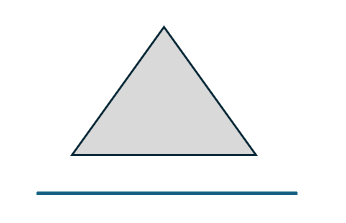
Potential meaning:
Grey can’t be the shape because the two shapes are different and yet both are ‘Grey’
Grey is the colour
Grey is the position
This is ‘Grey’:
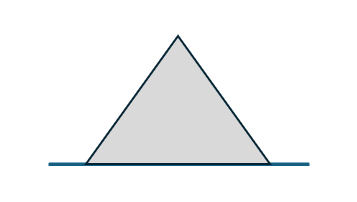
Potential meaning:
Grey can’t be the shape because the two shapes are different and yet both are ‘Grey’
Grey is the colour
Grey can’t be the position because this example is on the line while the other two were above the line and yet all three are ‘grey’.
Therefore, we know that ‘Grey’ is the colour.
This example string is effective because it uses variation theory where each example is clearly different from a previous example in one very precise and noticeable way. In a classroom, the teacher could of course, draw student attention explicitly to these differences to help students make accurate and precise meaning.
Use the power of story…
This doesn’t mean telling students lots of stories about our experiences in relation to the concept being learned. Research suggests that this could actually make student understanding more challenging for them to achieve. Rather, this is a case of maximising the impact of the characteristics of narrative in how meaning is communicated. Tom Sherrington wrote about this in a blog a few years back and identified four aspects of narrative that teacher explanation could draw upon. I think the same is true of all attempts to communicate meaning. The four characteristics are:
Conflict
Causality
Complications
Character
Take this example that utilises the four characteristics of story to explain how coastal erosion works:
Coastal erosion can be understood as a story in which the coastline and the sea are the main characters. The coastline, made up of cliffs, beaches, and sand dunes, stands at the boundary between land and water, while the sea, through its waves, tides, and currents, constantly interacts with it. The central conflict is the sea’s continual attempt to wear away the coastline. Every day, waves crash against the shore, and during storms they become even more powerful, putting greater pressure on the land.
This conflict leads to a chain of causes and effects. As waves repeatedly strike the coast, they break down rock and soil through processes such as hydraulic action and abrasion. Small pieces of rock are loosened and carried away by the water, gradually removing material from the shoreline. Over time, this causes cliffs to retreat, beaches to change shape, and the coastline to move further inland. In other words, the constant action of the sea causes erosion, and erosion causes the coast to change.
However, the story becomes more complicated because not all coastlines erode in the same way or at the same rate. Storms can dramatically increase the power of the waves, leading to rapid erosion in a short period of time. Different types of rock also respond differently; softer rocks erode much faster than harder rocks. Human actions, such as building sea walls and groynes, can protect some areas while increasing erosion elsewhere. Rising sea levels add another complication by allowing waves to reach higher parts of the coast and attack areas that were previously protected.
All four characteristics of story are present and as Daniel Willingham wrote in Why students don’t like school, the story is ‘psychologically privileged.’
So, in our quest to communicate meaning clearly, efficiently and effectively for students, we should aim for three things:
Know your stuff
Choose your examples wisely
Utilise story
If you enjoyed reading and want to hear the podcast episode linked to this post, you can find it on this link:
The podcast is also available on apple or wherever else you get your podcasts. Thanks for subscribing!